


In the first case of SPC enforcement at the UPC, the UPC Court of Appeal (CoA) recently awarded Merz a PI, overturning the first instance decision of the Paris LD.
The decision emphasises the need for case-by-case assessment of all the facts, with due regard to national procedure, when considering whether an applicant for a PI has acted with sufficient urgency. This much was already established (see Mammut v Ortovox and Boehringer Ingelheim v Zentiva). Importantly, it also highlights a PI applicant’s need for certainty of infringement within this context (whether imminent or actual) before seeking a PI.
In a procedural first, the CoA split the appeal to hear arguments on urgency first. Viatris was ordered to provide a Statement of Response in relation to urgency only, to be followed by a hearing on that issue alone. The CoA would then take a view whether to continue to seek submissions on the remaining arguments. The merits of the SPC and its underlying patent were ultimately not discussed before the CoA, Viatris having waived their invalidity defence just three days before the hearing. The focus of the CoA’s decision is therefore whether the Paris LD was correct to refuse Merz a PI at first instance on the basis that it had failed to demonstrate it was seeking provisional measures without any unreasonable delay (R. 211.4 RoP).
The Court of Appeal, following established case law on the importance of carrying out a case-by-case assessment of all circumstances, set aside the first instance decision, granting Merz a PI.
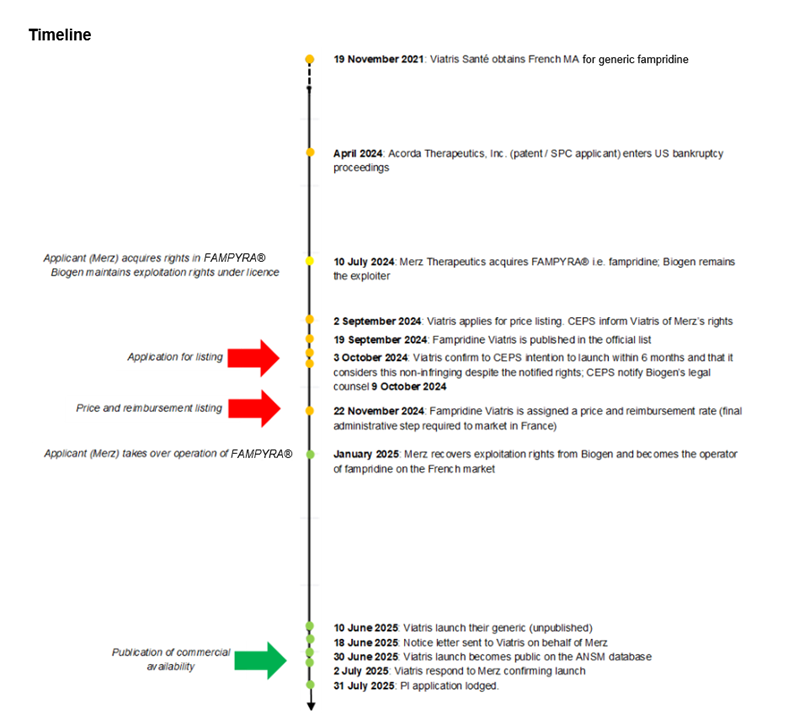
Decision of Paris LD – Price listing starts clock for undue delay
At first instance, the Paris LD treated finalisation of the administrative procedure for Viatris’ generic fampridine (i.e. price listing) on 22 November 2024 as the indication of imminent infringement. When determining the point of awareness which triggers the “starting of the clock” for undue delay (R 211.4 RoP), the Paris LD found that Merz should have become aware of the imminent infringement at several points earlier than July 2025, when it filed for a PI:
It “seem[ed] clear that Biogen [the exploiter] informed the patent holder for which it held the rights [by then Merz] that an infringement was imminent on the French market” due to the correspondence with CEPS in the latter half of 2024.
On acquiring the rights in FAMPYRA® in July 2024; or at least on recovery of exploitation rights in January 2025, Merz ought to have carried out an audit (due diligence) of the rights and become aware of the imminent infringement.By lodging a PI application on 31 July 2025, the Paris LD therefore considered that Merz first sought the PI “six months after it became or should have become aware of the imminent launch of the generic product on the French market”.
Court of Appeal finds no sufficient certainty of imminent infringement before publication on the national medicines database
The CoA considered that the Paris LD’s conclusions about Merz’s awareness of imminent infringement were based on “double assumptions”, a) that “Biogen was informed by CEPS” of Viatris’ intended launch within 6 months of price listing; and b) “Biogen informed the right holder”.
The CoA stressed the level of certainty of [imminent] infringement required of an applicant, noting that “the standard of proof is whether there is a sufficient degree of certainty, so that the Court is satisfied that on the balance of probabilities it is more likely than not that there is a patent infringement or that an infringement is imminent.”
Events at various points in time were assessed with regard to whether this certainty threshold had been met before 31 July 2025, namely:
On application for listing (October 2024);
Importantly (given how the CoA’s comments in Boehringer Ingelheim v Zentivaare often – slightly incorrectly – recited) the price publication is the final administrative step required to market medicines in France. After this, only the generic’s decision not to launch prevents it infringing.
This decision cited and put into context the test for imminent infringement set in Boehringer Ingelheim vs Zentiva, i.e. that the “Completion of the national procedures for health technology assessment, pricing and reimbursement for a generic medicine may amount to an imminent infringement. The assessment must be made with due regard to the national regulatory and legislative context and considering the circumstances of the case.” (emphasis added). The CoA held that in the circumstances of this case, Merz had shown that it did not have sufficient certainty that infringement was imminent prior to publication of commercialisation in the French national medicines database. Key circumstances were:
- Merz only took over operation of the product in question in January 2025, and there was nothing to indicate that information about Viatris’ intended launch timeline was passed on to Acorda or Biogen, let alone Merz, by the previous owners/operators or by CEPS;
- The argument that French regulation requires generics to launch within 6 months of price/reimbursement listing was wrong. The relevant provision of the French regulation in fact indicates that generics should not be listed more than 6 months before expiry of relevant intellectual property rights. Only where the generic company notifies CEPS that it believes it can market the generic without infringing the declared rights (as Viatris did in this instance in their communication of October 2024), does the product proceed to be listed.
- Evidence submitted by Merz that many generics often defer launch by as much as two and half years, or positively commit not to launch before patent expiry, was persuasive
Key takeaway
This Kat believes that this decision is a good example of how the UPC will dive into the facts of each case to assess whether there has been a trigger for a PI on threat of infringement. The CoA was prepared in this case to take into account circumstances and evidence from both parties indicating that the applicant should or should not have been sufficiently certain that infringement would in fact materialise imminently, and analysed this specifically within the national regulatory and legislative context of the relevant market. A patentee will not be deprived of its right to seek a PI in cases where some facts may suggest future infringement is possible but imminence uncertain. The CoA is completely in line with the holistic approach already set out in Boehringer Ingelheim v Zentiva, reiterating the factors that come into play when considering urgency.